MASH is the American crash-test standard for roadside safety hardware, and US highway agencies require it for new permanent barrier installations.
The Manual for Assessing Safety Hardware (MASH) is published by AASHTO, the American Association of State Highway and Transportation Officials. It sets out how permanent and temporary highway safety features are crash tested and how the results are judged. The current edition, MASH 2016, replaced the earlier NCHRP Report 350.
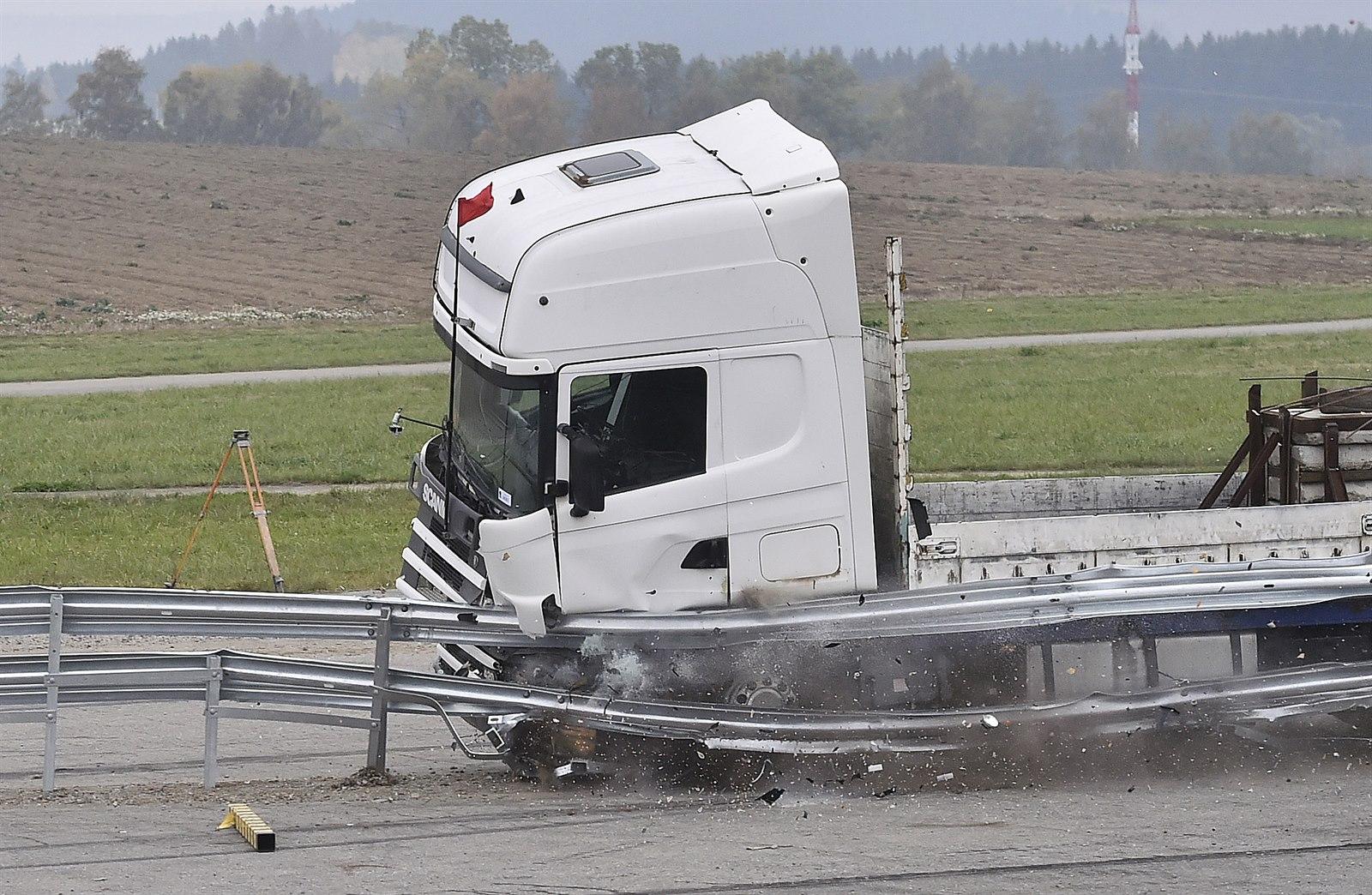
MASH updated the test vehicles, the number and conditions of the tests, and the evaluation criteria, so that barriers are proven against the vehicles on today's roads.
The small passenger car test vehicle grew from 820 kg to 1,100 kg.
The pickup test vehicle grew from 2,000 kg to 2,270 kg.
The small car impact angle rose from 20 to 25 degrees.
| Test level | Test vehicles | Impact speed and angle | Typical use |
|---|---|---|---|
| TL-3 | 1,100 kg car and 2,270 kg pickup |
100 km/h at 25 degrees | High-speed highways and expressways |
| TL-4 |
TL-3 vehicles plus a 10,000 kg single-unit truck |
Truck at 90 km/h and 15 degrees | Roads with heavier truck traffic |
| TL-5 |
TL-3 vehicles plus a 36,000 kg tractor-van trailer |
Truck at 80 km/h and 15 degrees | Bridges, interchanges, high-risk locations |
MASH defines six test levels in total, from TL-1 for low-speed roads up to TL-6 with a tank trailer. A system earns a test level only by passing every crash test required for that level, judged on three things: whether the barrier contains and redirects the vehicle, the forces on the occupants, and how the vehicle behaves after the impact.
In the United States, the Federal Highway Administration issues eligibility letters for crash-tested systems, for example for a 31-inch W-beam guardrail tested to MASH TL-3. Under the joint AASHTO and FHWA implementation agreement, new W-beam barriers on federal-aid highway projects had to be MASH-tested from the end of 2017, and other longitudinal barriers, transitions and bridge rails from the end of 2019. MASH is not a one-off label: it is the working standard for a large and growing body of tested hardware.